Introduction by Ellie Farrell
Pride flags are a statement, not decor, fact. Like so many others, wedding suppliers display striped flags with rainbow colours. On the websites, business cards, social media and wedding fair stands of celebrants and photographers. When we see a Pride flag or rainbow, what does it mean? Do we think the displayer advocates acceptance, support, acknowledgement, unity, and celebration? Displaying the flag is a statement of solidarity. Solidarity for and with LGBTQ+ communities. If you are part of the LGBTQ+ community, informing prospective clients you have an understanding of their needs is acceptable and welcomed. What isn’t acceptable is using the Pride flag as a marketing tool to gain money from those who are part of these communities, it is as Stonewall states on their website an acknowledgement:
‘that we want to live in a world where no one is discriminated because of who they are or who they love. We imagine a world where all LGBTQ+ people are free to be themselves and we can live our lives to the full.’ Stonewall.org
The Stonewall Uprising
Between 28th June and 3rd July 1969, a series of police raids took places at The Stonewall Inn in Greenwich Village New York. The bar was a safe place for gay people to go to. Storme Delarverie, Marsha P. Johnson, and Sylvia Rivera were three of the regulars at The Stonewall Inn who fought back.
These three people and many others campaigned for acceptance and equality for members of the gay community to be treated with respect, dignity and to be able to be who they were.

The Pride Flag
The Pride flag is a symbol of progress, and solidarity to those who initially took a stand during the Stonewall uprising of June 1969 and who fought for gay rights. A year after the events on 28th June 1970, a march took place in New York to commemorate the uprising. This became an annual event that was urged to be adopted in other cities.
June is now Pride month, and the flag comes out, (no pun intended) as people celebrate Pride. This marks the anniversary of the Stonewall uprising and the start of the gay rights movement.
Written by Nicky Sutton
The Origins of the Pride Flag
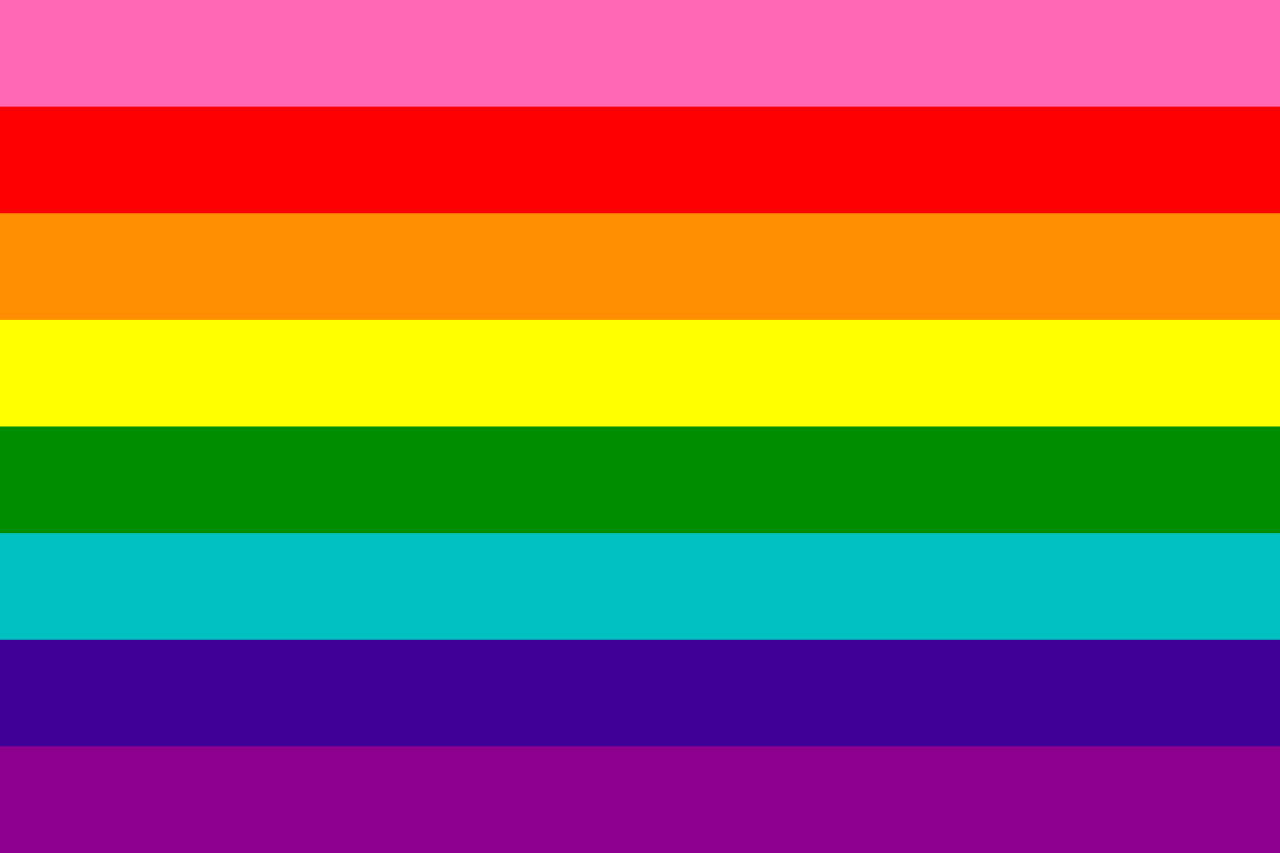
The Pride flag was created in 1978 by Gilbert Baker. Baker wanted to celebrate members of the gay and lesbian political movement and saw flags as the most powerful symbol of pride. To Baker a rainbow was a natural flag from the sky, so he adopted the eight colours of the rainbow for the stripes.
Each colour had its own meaning:
hot pink for sex
red for life
orange for healing
yellow for sunlight
green for nature
turquoise for art
indigo for harmony
violet for spirit
Early versions of the flag were made by hand and were first flown in June 1978 for the San Francisco Gay Freedom Day Parade. Following its success the flag was put into mass production. Due to some issues with supply of some of the colours, the pink and turquoise stripes were removed, and indigo was replaced with basic blue, resulting in the contemporary six striped flag of red, orange, yellow, green, blue, and violet. This became associated with the lesbian, gay and bisexual (LGB) community, as it was then known.
Evolution of the Pride Flag
Over the years subgroups have emerged withing the LGB community and many variations of the flag have appeared, there are currently 32 variants of the Pride flag as some subgroups are more visible than others. Redesign projects looked to increase the representation of discriminated minority identities within the community. In 2017, a Pride flag including black and brown stripes to highlight the discrimination of black, and brown members of the community was revealed in the United States. Considering two of the three main people accredited to be at the forefront of the uprising were of biracial and black ethnicities, why did representational colours take nearly 38 years to be included within the flag?
In 2018 the Progress Pride flag was developed by non-binary American artist and designer Daniel Quasar. Their redesign was to celebrate the diversity of the lesbian, gay, bisexual, trans and queer + (LGBTQ+) community and to call for a more inclusive society.
The new design included five new colours; black and brown to represent people of colour, with the black stripe having a double meaning, also for those living with AIDS and those who died from the disease. The pink, light blue and white to represent trans, gender non-binary, intersex, and those across the gender spectrum.
The additional colours were originally stacked on top of the original colours, this caused legibility problems, Quasar resolved this design issue by placing the additional colours in the shape of an arrow, on the left of the Progress Pride flag, pointing to the right to demonstrate forward movement.
Everyone is Unique
When many wedding celebrants and suppliers (and some funeral industry suppliers) seem to assume the LGBTQ+ community should be drawn to everything rainbow coloured. While there may be a very subtle nod to those who fought for the rights we have today and all that has been achieved with Pride, coloured ribbons for a handfasting or a pair of rainbow socks maybe enough for those the ceremony is for.
A wedding between a same sex couple is likely to have the same décor and feel as any other wedding, whether it be traditional, alternative, or themed. If as a wedding celebrant you want to engage with same sex couples, then treat them the same as you would with any other couple.
Likewise, we see so many wedding celebrants and wedding suppliers using a logo, often involving rainbow colours, stating the fact that they are LGBTQ+ inclusive, friendly or an ally of the community. Because everyone is unique, many could welcome this and be likely to approach the stand at a wedding fair or send an email to the supplier knowing they won’t be judged nor discriminated against for being who they are. (Although this is a hate crime and illegal, it is still happening).
Others may be put off as why should we need to display anything to say we stand with a community of people? Surely everyone should be made to feel welcome, not singling out any group. Many (including myself) are against categorising to be accepted. Aren’t we just like any other human being or do we have to have to adhere to labelling before we earn that right?
The original Pride flag is a symbol of solidarity not categories. When and where it is displayed is a statement that everyone is welcomed equally. We are stating we are taking a stand with a community of people, not trying to make money from them. We want all to feel welcome and important, especially for a wedding as it has taken many years, sacrifices, an uprising, sorrow, deaths, and exclusion to get the same rights as hetero people.
How Inclusive are we Really as Celebrants?
To me, and other members of our community, I don’t feel the need to categorise myself, as far as I’m concerned, I’m no different to anyone else, (my personal choice as that is what the Stonewall uprising was about). There are many of us who have concerns of tokenism. There is a fine line between those who are supporting us, and those that think ‘the gay pound’ – a derogative term used in the past – is something they want to benefit from, or it makes them look good as a supplier.
If you stand with people and want them to feel represented and included, use real images on your websites, social media, and wedding fair stands. There are many royalties free stock images sure, but most portray a stylised idea of what LGBTQ+ people look like. Many are actual hetero people posing as something other. If you haven’t been involved with any weddings other than those for hetero people, ask any LGBTQ+ friends or family members to pose for you. Real people being who they are, that is why this all began. This shows you really do stand with a community of people, and you are inclusive.
Conclusion by Glenn Jenkins
Not Every Couple Wants Rainbow Colours
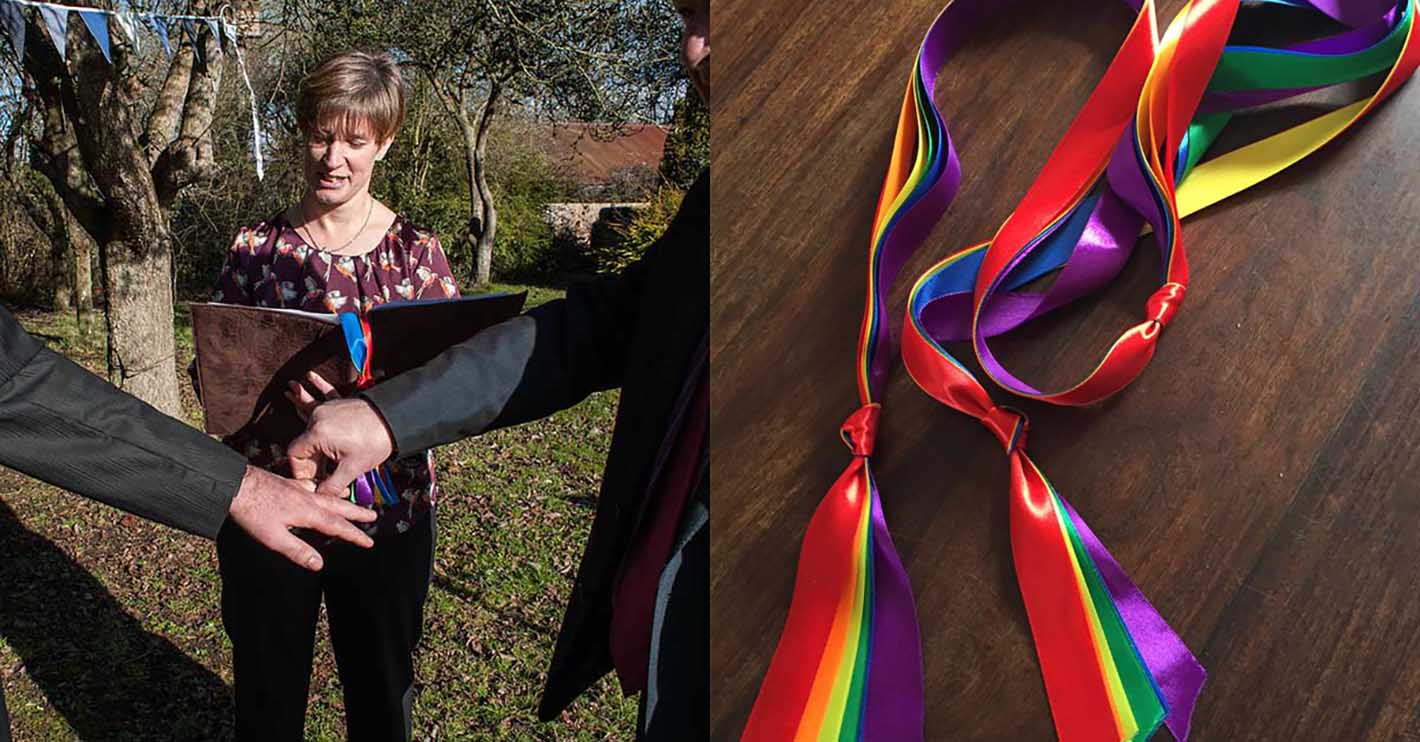
We should never assume anything right? This includes assuming every set of clients want their wedding decorated with rainbow colours. Sure include it if it’s asked for, and make suggestions if asked, but don’t assume everyone wants rainbow décor as everyone is different. Handfasting ribbons in the Pride flag colours is a good suggestion as each ribbon has a meaningful representation and this gives a nod of remembrance to all those who fought for us to be accepted as equals. The Pride colours are an important part of our history, but there is loads more to us than just eight colours.
Gay Weddings Don’t Exist
Finally, and it’s a big finale, many still say ‘gay wedding’, people are gay, a wedding isn’t. A wedding doesn’t need to be given a gender nor does it need to be given a sexuality. Of course, when working with clients, their wants, needs and terminology should be listened to and used.
Gay Funerals Don’t Exist Either
There are rainbow hearses, which some funeral directors like to post images of during Pride Month. There are also rainbow coffins and ashes urns too, but there isn’t such a ‘thing’ as a gay funeral. The Pride flag can have a presence at the funeral or memorial ceremony of a person who was a member of the LGBTQ+ community, if it is requested. It doesn’t come as standard. A person’s life and everything they meant to people isn’t defined by different coloured stripes. It is defined by all they achieved, what they gave to others, how loved they are, and how they lived their life as an individual.
Pride Flags are a Statement, Not Decor
When exhibiting at wedding fairs, (or at funeral or community events), it is important to remember Pride flags are a statement, not decor. if you display a Pride flag, this is making a statement; a statement that makes everyone feel accepted and important. This may make some couples feel you’re approachable and inclusive. As mentioned there are variations of the Pride so choose the version which represents everyone.
Would you display ‘I do heterosexual weddings’, no you wouldn’t. As many display ‘love is love’ why do we have to label it as a same sex wedding? Diversity and equality aren’t selling points, they are expectations all are equally represented. Be respectful, it’s ok to ask people what pronouns they use. Many businesses and companies (including individual people) display their pronouns on emails, on badges, or on their stands. All people are individuals, all relationships matter.
If two guys have a wedding, it isn’t an ‘alternative wedding’. If two women have a wedding, it isn’t an alternative wedding. If two people who identify as non-binary have a wedding, that isn’t an ‘alternative wedding’ either. If a gay guy and a person who identifies as non-binary have a Hollywood themed wedding, this may be labelled as an alternative wedding. Not because of the gender labels of the people, but because of the theme and the ceremony content based on that theme.
What is alternative about two people in love? It’s been happening since humans walked the earth. Do the job for the love of love, because love is the reason the role of a celebrant exists. Celebrants celebrate love and individuality, not sexuality. Remember, Pride flags are a statement, not decor.